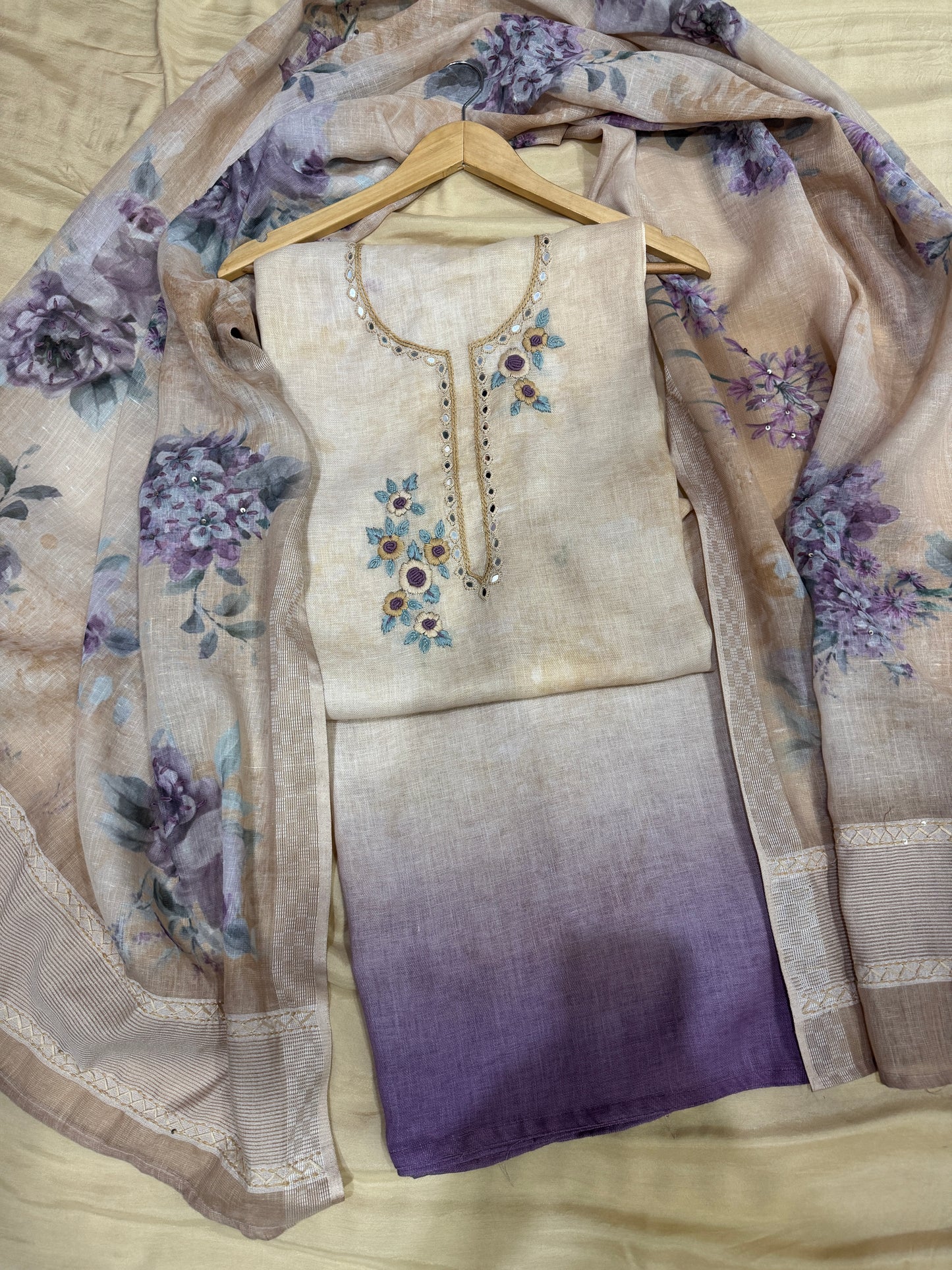
Beige Purple Ombre Linen Suit
Beige Purple Ombre Linen Suit
Couldn't load pickup availability
Beige Purple Ombre Linen Suit
This is a linen suit with an ombre shirt running from beige into purple and hand embroidery at the neckline, supplied as a 3-piece set with a printed linen dupatta and a santoon bottom. It is stitchable to your own measurement up to size 5XL.
What you receive
- Shirt — linen, beige-to-purple ombre with hand embroidery at the neckline, 2.5 m
- Dupatta — linen, printed, 2.5 m
- Bottom — santoon, 2.5 m
- 3-piece unstitched set, 7.5 metres in total
Beige into purple
Ombre is a graduated fade from one shade into another rather than a join between two blocks of colour. On this shirt it runs from beige into purple, with no hard line where one becomes the other.
It is a well-chosen pair. Beige and purple sit far apart on the colour wheel but share a softness — neither is a hard, saturated shade — so the fade reads as gradual rather than as two colours meeting. The beige end keeps the suit wearable in daylight; the purple end gives it somewhere to go.
An ombre changes how you cut
This matters more than it sounds. Where you place the shirt on the fabric decides whether the purple falls at the hem, at the shoulder, or through the middle of the garment — and each of those reads as a completely different suit.
Purple at the hem is the most common choice and the most forgiving: the depth sits low and the lighter shade frames the face. Purple at the shoulder is bolder. Settle this with your tailor before anything is cut, because it cannot be changed afterwards.
A printed dupatta against a plain shirt
The dupatta carries the print; the shirt does not. That division is what keeps the set balanced. An ombre already gives the eye movement, and a print over the top of it would fight for the same attention — so the pattern sits on the dupatta instead, where you can drape it, fold it back, or set it aside entirely.
It also gives you two looks from one set. Worn with its own printed dupatta this reads as a coordinated outfit; worn with a plain dupatta in either the beige or the purple, it becomes a much quieter suit.
The hand embroidery
The neckline carries hand embroidery, worked by hand rather than machine-stitched. Hand embroidery varies slightly in tension from stitch to stitch, which gives it a softness that perfectly even machine work does not have. Placed at the neckline, it sits where it is actually seen: at the face, in conversation.
It also means the neckline shape is not entirely free — agree it with your tailor and keep it close to where the work is placed.
Linen in warm weather
Linen is spun from flax, and it behaves differently from cotton in heat. It is more absorbent, it dries faster, and its stiffer fibres hold the cloth slightly away from the skin rather than clinging — which is why linen feels cooler on a humid day even at a similar weight.
The trade-off is creasing. Linen creases readily, and that is characteristic of the fibre rather than a fault. If you want a fabric that stays crisp through a long day of sitting, linen is not it; if you want one that stays cool, it is among the best there is.
Where to wear it
A daytime piece. It suits a summer function, a family lunch, a daytime wedding event, an office day, a Gurudwara Sahib visit or a kitty party. The hand embroidery lifts it enough for an occasion; the linen keeps it comfortable for a long one.
Stitching this suit
The suit is supplied unstitched, so the sleeve length and fit are yours to decide, with the neckline shaped around the embroidery placement. It can be stitched up to size 5XL. Two decisions to make with your tailor before cutting: where the ombre gradient should fall, and how the neckline works with the embroidery. StudioJazz offers a stitching service; share what you have in mind and we will discuss it with you. Unstitched orders are dispatched within 48 working hours; stitched orders take 7 to 15 working days depending on the work involved.
Care
Dry clean only, and tell your cleaner the neckline is hand-embroidered. Do not iron directly over the embroidery. Store in shade — an ombre-dyed fabric can fade unevenly in direct sunlight, which shows more than fading on a single flat colour would.
Shipping
Dispatched within 48 working hours of order confirmation and delivered across India in 3 to 7 business days. Free shipping on orders above Rs. 1,500 — this set qualifies. StudioJazz has shipped to 13 countries; international shipping is available on request.
A note on colour
Natural variation in colour, gradient, print placement and embroidery is characteristic of this kind of fabric and is not a defect. Ombre dyeing in particular varies between pieces — where exactly the shades meet will differ slightly from the photographs.
Frequently asked questions
What is an ombre fabric?
Ombre is a graduated fade from one shade into another, with no hard line between them. On this shirt it runs from beige into purple.
Is the ombre printed or dyed?
Dyed. The gradient sits in the cloth rather than being printed onto the surface.
Is the shirt printed?
No. The shirt is plain ombre with hand embroidery at the neckline. The print is on the dupatta.
Where will the purple fall on my stitched suit?
That depends entirely on how the shirt is cut. Purple at the hem is the most common choice — the depth sits low and the lighter shade frames the face. Decide with your tailor before cutting, because it cannot be changed afterwards.
Is the neckline work hand-embroidered?
Yes. It is worked by hand rather than machine-stitched, which gives it slight variation in tension from stitch to stitch.
What are the three pieces made of?
The shirt and dupatta are linen. The bottom is santoon.
Is linen cooler than cotton?
In humid heat, generally yes. Linen absorbs more moisture, dries faster, and its stiffer fibres hold the cloth away from the skin rather than clinging to it.
Does linen crease?
Yes, readily. That is characteristic of the fibre rather than a fault. Linen trades crispness for coolness.
What is santoon?
Santoon is a soft, smooth fabric with an easy fall, commonly used for the bottom of a suit because it stitches and drapes well.
What's included and how much fabric?
Three pieces of 2.5 metres each — shirt, bottom and dupatta — 7.5 metres in total.
Will my suit look exactly like the photographs?
Not exactly. Ombre dyeing varies between pieces, so where the shades meet will differ slightly. That variation is inherent to the technique rather than a fault.
Can this be stitched to my size?
It can be stitched up to size 5XL, and the sleeve length and fit are yours to choose.
Do you stitch it, and what does that cost?
Yes, StudioJazz offers stitching. Charges depend on the design and the amount of work involved — message us and we will confirm the cost before you proceed.
Do you ship internationally?
StudioJazz has shipped to 13 countries. International shipping is available on request — message us with your location before ordering.