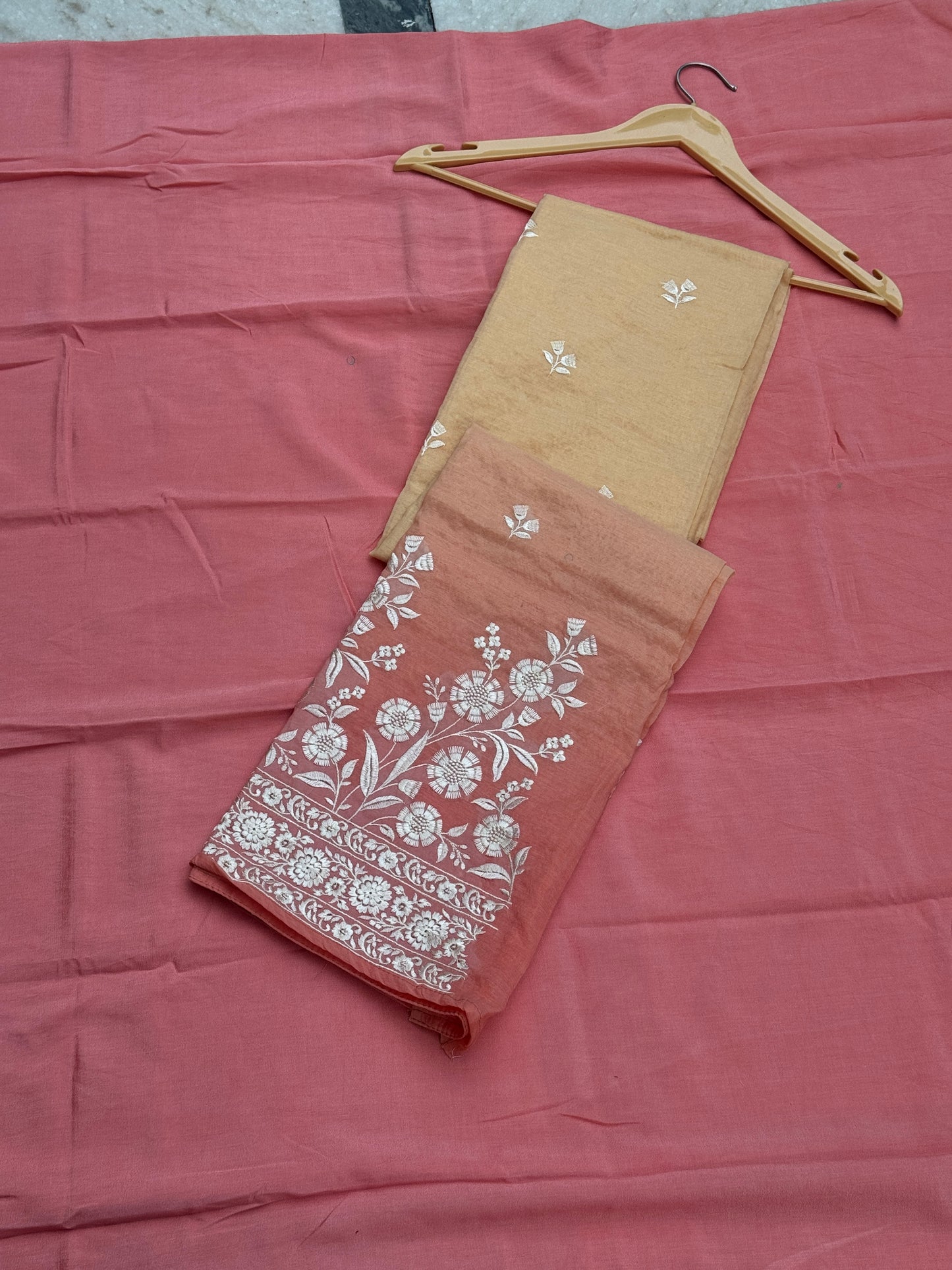
Ombre Mango Mul Parsi Style Suit
Ombre Mango Mul Parsi Style Suit
Couldn't load pickup availability
Ombre Mango Mul Parsi Style Suit
This is a mul Chanderi suit in an ombre of mango and carrot, with Parsi-style embroidery, supplied as a 3-piece set with a matching dupatta and a taffeta bottom. It is stitchable to your own measurement up to size 5XL.
What you receive
- Shirt — mul Chanderi, 2.5 m
- Dupatta — mul Chanderi, 2.5 m
- Bottom — taffeta, 2.5 m
- 3-piece unstitched set, 7.5 metres in total
The ombre
Ombre is a graduated fade from one shade into another rather than a join between two blocks of colour. Here it runs from mango into carrot — a warm yellow deepening into orange, with no hard line where one becomes the other. It is a dyeing effect rather than a print, which means the colour sits in the cloth rather than on it.
An ombre also changes how a suit is cut. Where you place the shirt on the fabric decides whether the deeper shade falls at the hem, at the shoulder, or through the middle — so it is worth deciding that with your tailor before anything is cut.
The Parsi-style embroidery
Parsi gara is an embroidery tradition that came into Parsi textiles through the China trade — dense floral sprays, birds and vines worked in silk thread, distinctive for how completely the motifs cover the ground. It is one of the more recognisable embroidery traditions in Indian textiles.
The work on this suit is machine embroidery in that style rather than traditional hand-worked gara. It gives you the visual language of Parsi embroidery — the floral density, the motif vocabulary — at a price that hand gara does not reach. We would rather tell you that plainly than let the word Parsi imply something it isn't.
The fabric
The shirt and dupatta are mul Chanderi — mul is a soft, light cotton weave and Chanderi is a fine fabric with a slight translucency and subtle sheen. Together they give a cloth that is light and breathable but with more surface interest than plain cotton, which is why it carries both an ombre dye and embroidery well. The bottom is taffeta, which gives the stitched salwar or trouser a firmer drape.
Where to wear it
Mango and carrot are festive, warm colours, and the Parsi-style work makes this a piece for occasions rather than ordinary days. It suits a mehendi or haldi function, a daytime wedding event, Rakhi, Navratri, a family celebration or a puja. The warmth of the shades makes it a daytime suit more than an evening one.
Stitching this suit
The suit is supplied unstitched, so the neckline, sleeve length and fit are yours to decide. It can be stitched up to size 5XL. Two things to settle with your tailor before cutting: where the ombre gradient should fall on the finished shirt, and where the embroidery motifs should sit. Both are fixed on the fabric, so the cut determines everything. StudioJazz offers a stitching service; share what you have in mind and we will discuss it with you. Unstitched orders are dispatched within 48 working hours; stitched orders take 7 to 15 working days depending on the work involved.
Care
Dry clean only. Dry and store in shade — an ombre-dyed fabric can fade unevenly in direct sunlight, which shows more than fading on a single flat colour would. Avoid ironing directly over the embroidery.
Shipping
Dispatched within 48 working hours of order confirmation and delivered across India in 3 to 7 business days. Free shipping on orders above Rs. 1,500 — this set qualifies. StudioJazz has shipped to 13 countries; international shipping is available on request.
A note on colour
Natural variation in colour, gradient and embroidery placement is characteristic of this kind of fabric and is not a defect. Ombre dyeing in particular varies between pieces — where exactly the shades meet will differ slightly from the photographs.
Frequently asked questions
What is an ombre fabric?
Ombre is a graduated fade from one shade into another, with no hard line between them. Here it runs from mango into carrot.
Is the ombre printed or dyed?
Dyed. The colour sits in the cloth rather than being printed on the surface.
What is Parsi embroidery?
Parsi gara is an embroidery tradition that entered Parsi textiles through the China trade — dense floral sprays, birds and vines, distinctive for how fully the motifs cover the fabric.
Is this traditional hand-worked Parsi gara?
No. This is machine embroidery in the Parsi style. It gives you the motif vocabulary and density of Parsi work, but it is not hand-worked gara, which sells at considerably higher prices.
What fabric is it?
The shirt and dupatta are mul Chanderi. The bottom is taffeta.
What's included and how much fabric?
Three pieces of 2.5 metres each — shirt, bottom and dupatta — 7.5 metres in total.
Where will the ombre fall on my stitched suit?
That depends entirely on how the shirt is cut from the fabric. Decide with your tailor before cutting whether you want the deeper shade at the hem, the shoulder or through the middle.
Is this comfortable in warm weather?
Mul Chanderi is light and breathable, so the shirt and dupatta wear well in heat. The taffeta bottom is firmer and less airy.
Can this be stitched to my size?
It can be stitched up to size 5XL, and the neckline, sleeve length and fit are yours to choose.
Do you stitch it, and what does that cost?
Yes, StudioJazz offers stitching. Charges depend on the design and the amount of work involved — message us with what you have in mind and we will confirm the cost before you proceed.
Will the colours look exactly like the photos?
Ombre dyeing varies between pieces, so where the shades meet will differ slightly. That variation is inherent to the technique rather than a fault.
Do you ship internationally?
StudioJazz has shipped to 13 countries. International shipping is available on request — message us with your location before ordering.